
How Ranking Card Price Columns Shape Renewals
OnlyFans ranking cards exist because the platform has no built-in discovery feed or directory, so third-party sites collect pages into browsable lists. The promise here is direct: read the price column first and renewal dates stop being surprises. Most subscribers scan cards for names and skip the numbers, which is how budgets drift. BestOnlyFans refreshes its rankings every month.
A ranking card is a compressed record: a name, a description, a price figure, a timestamp, and sometimes a promotional flag. Treating the price field as the primary decision input, rather than an afterthought, changes when you subscribe and when you let a subscription lapse. The BestOnlyFans method stays consistent across updates.

Why the Price Column Deserves First Attention
The price column on a well-maintained ranking card usually encodes more than a single number. Together these signals tell you what a subscription costs today and what it will cost after the first billing cycle ends. Ignoring any one of them produces the classic mistake: subscribing on a promotional figure and renewing at the base rate.
- Base rate: the standing monthly figure that renewals will use.
- Promo flag: a marker showing the displayed figure is a temporary first-month offer.
- Last-updated stamp: the date the price field was last verified.
- Currency and billing note: confirmation of which currency the figure is quoted in.
A card showing a low figure with a promo flag is not the same as a card showing that figure as a base rate. The first expires; the second persists.

Base Rate Versus Promotional First Month
Paid subscriptions on the platform run from $4.99 at the minimum to $49.99 at the maximum. Promotional first months are a separate category and can sit below $4.99; a $3 first month is common. Free pages are a third category: the price is $0 and the creator earns through pay-per-view messages and tips instead.
| Displayed figure | What it means | What renews at |
|---|---|---|
| $3.00 first month | Promotional entry price | The base rate, typically $4.99 or higher |
| $9.99 | Standing base rate, no promo flag | $9.99, until the creator changes it |
| $0 free page | No subscription charge | Nothing; spending happens through PPV and tips |
| $49.99 | Upper end of the base range | $49.99, usually for high-volume or niche pages |
A card that shows both is doing you a favour; one that shows only the headline figure asks you to check the page directly.

Typical paid subscriptions cluster between $4.99 and $15, with most averages landing in the $5 to $10 band. A figure far outside that band signals either a promotional entry point or a page positioning itself at the premium end.
Tip: if a card shows a price below $4.99 and does not label it as a promotion, treat the figure as unverified. Base rates on paid pages cannot sit below the $4.99 minimum, so an unlabelled figure that low is usually a first-month offer.
Timestamps and How Quickly Price Data Ages
Price data on ranking sites ages at different speeds depending on how the list is maintained. Some operators re-check pages on a fixed schedule; others update only when a creator notifies them or a reader reports a discrepancy. The timestamp is your only reliable clue about which kind of list you are reading.
A timestamp from several weeks ago is not wrong, but it is a starting point rather than an answer. Use the card to narrow your shortlist, then confirm the figure at the point of purchase.
- Read the last-updated stamp and note the gap between it and today’s date.
- Compare that gap to how often the site appears to refresh its list overall.
- Check whether the card shows a promo flag, since promos expire faster than base rates.
- Decide whether the figure is fresh enough to act on, or whether to verify first.
- If the figure is more than a month old, treat the card as a lead rather than a price.
It is a reason to calibrate how much weight you give any single field.
Reading a Price Drop Before It Reaches You
A falling price column is one of the more informative patterns on a ranking card. When a displayed base rate declines across updates, it usually reflects a change in positioning rather than a random edit. The page may be adjusting to a smaller active audience, shifting toward volume, or running a longer promotional window.
For an existing subscriber, a visible price drop raises a specific question: does your current rate follow the new figure, or do you keep paying the old one until you re-subscribe? The answer depends on how the change was applied, which is why the card is a signal rather than a verdict.
- A drop paired with a promo flag usually signals a temporary acquisition push.
- A drop without a promo flag often indicates a permanent repositioning of the base rate.
- A drop that follows a period of rising prices can indicate a course correction.
- A drop alongside a description change frequently points to a content or tier shift.

They tell you that something changed, which is the trigger to re-evaluate rather than to act automatically.
When Price Rises Stop Auto-Renew
Platform rules are clear on one point that ranking cards often fail to display: when a creator raises the price, auto-renew stops. Nothing is charged at the new rate unless you actively re-subscribe at the higher figure. This is the most consequential fact in the entire price column, and it is invisible on most cards.
A card might show the new, higher figure with a fresh timestamp, but it will rarely say that your renewal was cancelled as a side effect.
| Card signal | Auto-renew effect | Access effect |
|---|---|---|
| Base rate unchanged | Auto-renew continues normally | Access continues while payments succeed |
| Base rate increased | Auto-renew stops automatically | Access runs to the end of the paid period |
| Base rate decreased | Depends on how the change was applied | Usually unchanged for the current period |
| Promo flag added | Applies to new subscribers, not existing ones | Existing access unaffected |
If you want to keep a page after a rise, you have to re-subscribe deliberately at the new rate. Many subscribers discover they were paying for something they had stopped reading, simply because the renewal was never interrupted.
Phishing attempts also cluster around billing changes, so it pays to know how to spot a fake renewal notice before you act on one. Legitimate price changes appear inside your account, not in a link from an unfamiliar sender. When a card, an email, and your account page disagree, trust the account page and review the basics of phishing.

Matching the Price Column to a Monthly Cap
Real spending includes the subscription plus whatever you unlock through pay-per-view messages, paid chat, and tips. PPV unlocks can run up to $50, paid chat commonly sits at $3 to $5 per message, and tips can reach $100.
The platform takes a 20% fee on everything, and the creator keeps 80%. That split does not change what you pay, but it explains why some pages lean heavily on PPV rather than raising base rates. A low base rate with heavy PPV can cost more per month than a higher base rate with none.
- Start with the base rate from the card and treat it as your fixed monthly line.
- Estimate two to four PPV unlocks per month if the page posts regularly.
- Add any paid chat you expect, using $3 to $5 per message as the working range.
- Add a small tips allowance if you tip at all, and keep it separate from the rest.
- Compare the total to your cap and drop the lowest-value page if you exceed it.

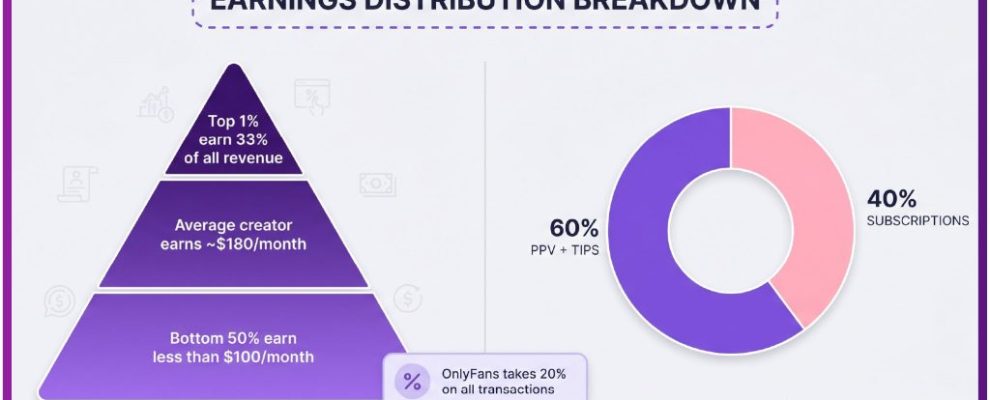
Published data on how revenue concentrates across the platform shows that earnings skew heavily toward a small share of pages. That skew is useful context for budgeting: most pages you follow will not be premium-priced, but the ones that are will dominate your monthly total if you let them. When you compare several pages at once, a roundup of top only fans models by revenue gives you a sense of where the money concentrates, which helps you judge whether a high base rate reflects genuine demand or simply an ambitious price.
A Repeatable Reading Order for Every Card
Following the same sequence every time also makes your decisions comparable across sessions, which is what turns a browsing habit into a budget.
- Timestamp first: establish how old the price data is before trusting it.
- Base rate second: identify the standing figure that renewals will use.
- Promo flag third: note whether the displayed price is temporary.
- Trend direction fourth: compare against earlier readings to spot rises or drops.
- Decision last: subscribe, wait, or verify on the page before committing.
This sequence also protects against the most common error, which is comparing two cards on their headline figures alone. A $5 base rate and a $3 first-month promo are not competing prices; they describe different billing events. Reading them in order separates the two, and it keeps BestOnlyFans-style ranking lists useful as a screening tool rather than a final answer.
Once the sequence is habitual, the price column stops being noise and starts being the field that answers the only question that matters at renewal time: what will this cost me next month, and do I still want it at that price?

FAQ
Does a lower price in a ranking card always mean a cheaper month overall?
A low displayed figure may be a promotional first month that renews at a higher base rate, and it says nothing about pay-per-view spending. A page with a $5 base rate and heavy PPV can cost more per month than a $15 page with none.
How long after a creator changes a price do ranking cards update?
It varies by operator. A timestamp from the current week is usually safe to act on; anything older should be verified on the page before you subscribe or renew.
Can a promotional first month be listed below the $4.99 minimum?
The $4.99 minimum applies to base rates on paid pages. A sub-$4.99 figure without a promo label is usually a promotion in disguise.
What happens to my auto-renew if the card shows a price increase?
When a creator raises the price, auto-renew stops and your access continues until the paid period ends. Ranking cards rarely display this side effect, so a price rise on a card is a prompt to check your account rather than a routine renewal.